When businesses compare office spaces, factors such as size, price, interiors and infrastructure usually receive immediate attention. But for businesses that regularly meet customers, partners, consultants or vendors, another factor can have just as much impact on everyday operations: client accessibility.
A well-designed office may create a strong impression once a visitor reaches it. The experience, however, starts much earlier.
How easy is the location to find? Can clients reach it from different parts of Pune? Is public transport available? Is parking manageable? Does the address require complicated directions?
These questions become especially relevant when businesses evaluate commercial office space in Central Pune, where location convenience can influence both the client experience and day-to-day business efficiency.
Client Experience Starts Before the Meeting
A client’s interaction with a business does not begin at the reception desk.
It can begin when they search for the office location, plan their route, choose a mode of transport and try to find the building.
If an office is difficult to reach, has confusing access or creates parking problems, the meeting may begin with unnecessary inconvenience.
On the other hand, an office in a familiar and accessible location can make the process simpler.
For client-facing businesses, accessibility therefore becomes part of the overall business experience rather than just a real-estate consideration.
This is particularly relevant for:
- Consultants
- Chartered accountants
- Lawyers
- Financial and advisory firms
- Healthcare professionals
- Architects and designers
- Agencies
- Business service providers
- Growing companies that frequently host partners or customers
For these businesses, choosing the right office space in Pune can influence how conveniently clients interact with the company.
1. A Familiar Location Makes Meetings Easier to Plan
Recognizable business locations reduce the effort required to explain where an office is situated.
When an address is located around an established commercial corridor, clients may already know the area or its nearby landmarks.
This simplifies:
- Sharing directions
- Planning meeting times
- Booking transport
- Coordinating with multiple visitors
- Reaching the office from different parts of the city
Central Pune areas benefit from familiarity because they have long been part of the city's commercial, institutional and professional landscape.
For businesses comparing office space in Central Pune, recognizability can therefore be an important practical advantage.
2. Road Connectivity Matters for Clients Coming From Different Areas
Not every client will travel from the same part of Pune.
One may be coming from Kothrud, another from Baner, another from Camp or another from Pimpri-Chinchwad.
For this reason, businesses should avoid evaluating an office location from only one commuting direction.
Instead, check:
- Access from major Pune roads
- Alternative approach routes
- Ease of entering and exiting the locality
- Peak-hour conditions
- Connectivity with surrounding business areas
A centrally located office can be useful when a business serves customers across multiple parts of the city.
The objective is not simply to choose the shortest route from one area, but to choose a location that works reasonably well for a wider client base.
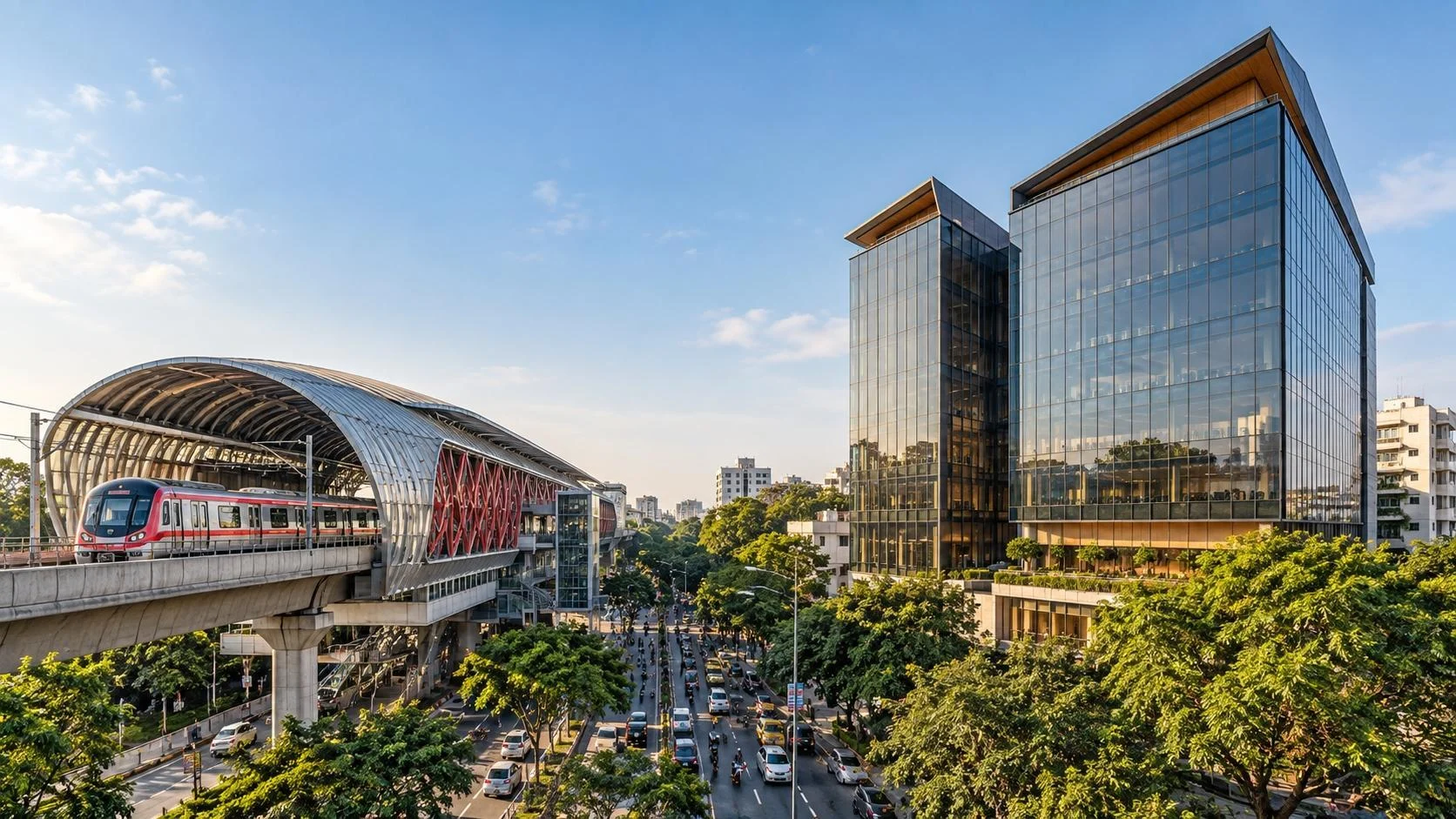
3. Metro and Public Transport Increase Accessibility
Client accessibility is not only about cars.
Some visitors may prefer the metro, bus, auto-rickshaw or a combination of public transport options.
An office located near established public transport can provide greater flexibility for clients who do not want to drive through the city or search for parking.
Businesses evaluating commercial office space in Pune should therefore consider:
- Metro accessibility
- Bus connectivity
- Auto and cab availability
- Last-mile convenience
- Walking conditions from public transport points
Public transport can be particularly useful for professional firms that receive frequent visitors throughout the working day.
4. Parking Can Influence the Entire Visit
Parking is sometimes treated as a secondary building amenity, but for client-facing offices it can directly affect the visitor experience.
A client arriving for an important meeting should ideally not spend unnecessary time trying to find a parking space.
When comparing office properties, businesses should understand:
- Whether visitor parking is available
- How parking is allocated
- Entry and exit movement
- Two-wheeler parking arrangements
- How mechanical or robotic parking works, where applicable
- Whether the system is practical during busy periods
The question should not simply be, “Does the building have parking?”
A better question is:
“How easy will parking actually be for someone visiting my office?”
This distinction becomes particularly important when considering commercial property in Central Pune, where parking availability may vary considerably between buildings.
5. Building Visibility Reduces Visitor Friction
Two properties may be in the same locality but provide very different arrival experiences.
An office located within a visible commercial building on a recognizable road may be easier for first-time visitors to find than an office hidden inside a smaller internal lane.
Businesses should evaluate:
- Building visibility
- Road frontage
- Signage opportunities
- Entrance visibility
- Ease of finding the lobby
- Drop-off convenience
For businesses that depend on client meetings, these seemingly small factors can influence how smoothly visitors arrive.
This is one reason office space on JM Road can be relevant to businesses looking for a recognizable Central Pune location, provided the individual building also offers suitable access and infrastructure.
6. The Surrounding Area Matters Too
Accessibility does not stop at reaching the building.
Clients may arrive early, stay for multiple meetings or need access to other services before or after the visit.
A strong surrounding business ecosystem can include:
- Restaurants and cafés
- Banks
- Hotels
- Professional services
- Medical facilities
- Retail
- Public transport
- Other commercial establishments
These facilities add practical convenience.
For businesses hosting out-of-city clients or partners, proximity to such services can make meetings easier to coordinate.
A commercial location should therefore be evaluated as part of the surrounding neighbourhood, not as an isolated building.
7. Client Accessibility Can Affect Meeting Frequency
When an office is easy to reach, arranging face-to-face meetings can become simpler.
This may be particularly useful for businesses where regular interaction matters, including:
- Professional advisory services
- Financial services
- Design consultations
- Legal meetings
- Sales discussions
- Vendor meetings
- Partnership discussions
A location that repeatedly creates travel difficulties may discourage unnecessary in-person visits.
An accessible location, by contrast, removes some of that friction.
That does not mean location alone creates stronger client relationships, but it can make meeting the business more convenient.
8. Accessibility Can Support a Professional Business Presence
Office address and accessibility are related, but they are not the same thing.
A recognizable location may contribute to brand perception, while accessibility determines how easily people can actually interact with the business at that location.
The strongest office decisions combine both.
For example, a business may choose an established address because it appears credible, but if clients struggle with access, parking or building entry, part of that benefit can be lost.
When evaluating commercial office space in Central Pune, businesses should therefore consider the complete visitor journey:
Finding the location → reaching the building → parking or drop-off → entering the office → attending the meeting.
Each stage contributes to the experience.
9. Accessibility Should Be Tested, Not Assumed
One of the simplest ways to assess an office is to visit it the way a client would.
Instead of looking only at maps or brochures:
- Travel to the property during business hours
- Approach it from different directions
- Check parking
- Find the building without relying on detailed instructions
- Walk from the nearest public transport point
- Observe entry and exit movement
- Check the lobby and visitor access process
This gives a much more realistic understanding of accessibility.
Businesses considering commercial property on JM Road or elsewhere in Central Pune should conduct this test before making a long-term office decision.
Client Accessibility vs Employee Accessibility
Both matter, but businesses should evaluate them separately.
Employee accessibility involves:
- Daily commuting
- Residential catchments
- Metro and bus access
- Parking
- Last-mile travel
- Peak-hour travel
Client accessibility involves:
- Ease of finding the office
- Road access
- Visitor parking
- Drop-off
- Building visibility
- Familiarity of the location
- Convenience for occasional visits
An office can perform strongly for employees but poorly for clients, or vice versa.
For businesses where both groups regularly use the office, the location should balance both requirements.
Why Central Pune Continues to Be Relevant for Client-Facing Businesses
Central Pune brings together established residential areas, professional services, commercial activity and multiple transport options.
Locations around JM Road, Deccan and Shivajinagar can therefore remain relevant for businesses that want clients to access them from different parts of the city.
However, businesses should avoid treating Central Pune as one uniform office market.
The exact road, building and micro-location can significantly change the experience.
A modern commercial building with suitable parking and access may provide a very different experience from an older property in the same locality.
That is why the correct comparison is not simply:
Central Pune vs another area
It should also be:
Building A vs Building B within Central Pune.
What Should Businesses Check Before Finalizing an Office?
When client accessibility is important, use this checklist:
- Is the address easy to recognize?
- Can clients reach it from multiple parts of Pune?
- Is metro or public transport available?
- Is the building easy to locate?
- Is road access straightforward?
- Is visitor parking available?
- Is drop-off convenient?
- Are the entrance and lobby easy to find?
- Are restaurants, banks and other services nearby?
- Does the building offer a professional visitor experience?
A property that performs well across these points is more likely to work practically for client-facing businesses.
Where Maverick Fits Into the Client Accessibility Conversation
Maverick by Namrata Group is located on JM Road, within Central Pune's established commercial environment.
For businesses evaluating commercial office space on JM Road, Maverick can be assessed through the same practical considerations discussed above, including road access, metro connectivity, parking, building visibility and convenience for employees and visitors.
The value of the JM Road address should therefore be considered together with the building itself.
For a client-facing business, the important question is not only:
“Is JM Road a good address?”
It is:
“Will this particular office make it easier for clients to reach and interact with my business?”
That is the more useful way to assess a commercial office decision.
Final Thoughts
Client accessibility may not be the first factor businesses think about when buying an office, but it can influence the working experience long after the purchase is complete.
A conveniently located office can make meetings easier, reduce visitor friction and help businesses maintain a professional and accessible presence.
For companies considering commercial office space in Central Pune, factors such as road connectivity, metro access, parking, building visibility and surrounding services should be evaluated alongside office size, price and infrastructure.
The right office should not only work from the inside.
It should also be easy for the people your business depends on to reach it.
FAQs
Why is client accessibility important when choosing office space?
Client accessibility affects how easily customers, partners and vendors can reach the business. Road connectivity, public transport, parking, building visibility and ease of entry can all influence the visitor experience.
What should businesses check when choosing office space in Central Pune?
Businesses should evaluate road and metro connectivity, employee and client access, parking, building infrastructure, office layout, surrounding services and long-term business requirements.
Is JM Road suitable for client-facing businesses?
JM Road is an established Central Pune corridor with access to surrounding commercial and residential areas. Businesses should still compare individual buildings based on parking, road access, visibility and infrastructure.
Does parking matter when choosing commercial office space?
Yes. For businesses that regularly receive clients, visitor parking and convenient vehicle movement can significantly affect the arrival experience.
Should businesses prioritize client access or employee access?
Businesses that frequently receive visitors should consider both. The appropriate balance depends on employee locations, client meeting frequency and the way the office is used.