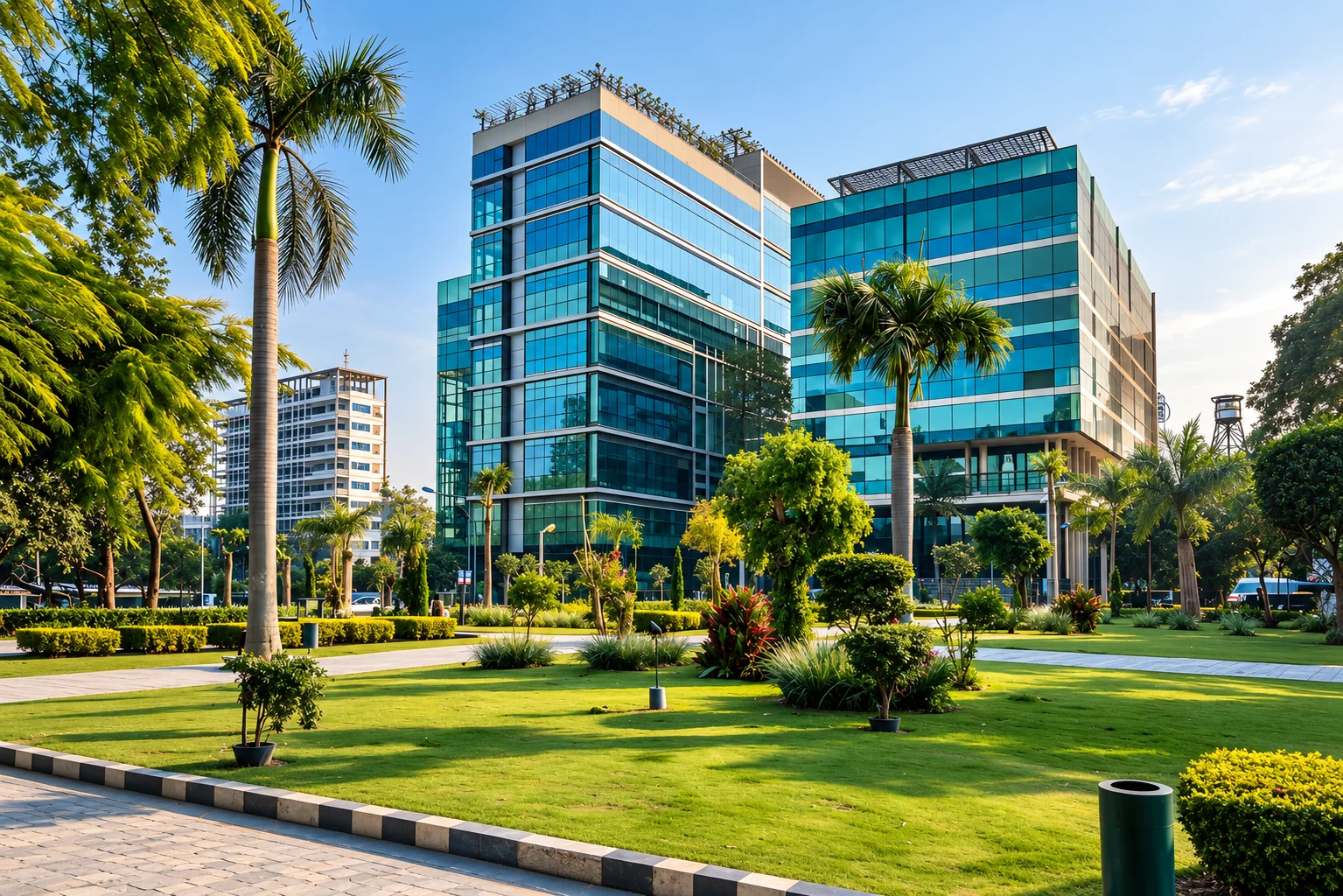
Online research can help businesses shortlist office projects, but a site visit often reveals things that photographs, brochures and floor plans cannot.
The actual road approach, parking experience, lift movement, natural light, office proportions, surrounding activity and overall building environment are much easier to understand when you physically visit the property.
For businesses evaluating commercial office space in Pune, a site visit should therefore be treated as more than a property tour. It is an opportunity to assess whether the office can actually support employees, clients and everyday business operations.
Here are the key things Pune businesses should check during a commercial office site visit.
1. Check the Actual Approach to the Project
Start assessing the property before you enter the building.
The address may look convenient on a map, but the real experience can vary depending on road access, traffic movement and the exact position of the building.
During the visit, check:
- How easy the building is to locate
- Main road connectivity
- Entry and exit points
- Whether vehicles can approach comfortably
- Availability of alternative approach roads
- Ease of cab and auto drop-off
- Traffic movement during working hours
Businesses receiving clients regularly should pay particular attention to whether a first-time visitor can find the property without complicated directions.
When comparing office space in Pune, this practical accessibility can matter just as much as the locality itself.
2. Visit During Normal Business Hours
A property can feel very different on a quiet weekend compared with a normal weekday.
Whenever possible, visit during actual office hours.
This allows you to observe:
- Road traffic
- Parking usage
- Lift waiting times
- Visitor movement
- Noise levels
- Activity around the building
- Public transport availability
- General functioning of the locality
If the office is being considered for long-term use, understanding its weekday environment provides a more realistic picture of what employees and clients will experience.
3. Understand the Parking System Properly
Parking is one of the easiest things to overlook during the buying process and one of the hardest things to change later.
Do not stop at asking, “Is parking available?”
Understand exactly how it works.
Check:
- Number of parking spaces associated with the office
- Two-wheeler parking
- Visitor parking
- Entry and exit process
- Mechanical or robotic parking, where applicable
- Waiting time
- Parking allocation
- Additional charges
- How busy the system becomes during peak periods
This is particularly important when comparing commercial property in Pune in established central locations, where parking arrangements can differ significantly between buildings.
4. Look at the Actual Office Dimensions
A floor plan gives one perspective. Standing inside the office gives another.
Check how the space feels in practice.
Look at:
- Length and width of the office
- Position of columns
- Window locations
- Entrance position
- Ceiling height
- Natural light
- Shape of the floor plate
- Areas that may be difficult to use
Two offices with similar carpet areas may accommodate very different layouts.
Businesses should think about where workstations, cabins, meeting rooms, reception, storage and collaboration spaces would realistically fit.
This is more useful than comparing properties based only on the number of square feet.
5. Imagine the Office With Your Actual Team Inside
Do not inspect an empty office only as an empty space.
Visualize how your business would operate there.
Ask:
- Where would employees sit?
- Where would clients wait?
- How many meeting rooms could realistically fit?
- Can cabins be created without making the office cramped?
- Is there space for storage?
- Where would a pantry go?
- Can teams move around comfortably?
- Could the layout be modified later?
This helps determine whether the office configuration suits your business rather than simply looking attractive during the visit.
7. Inspect the Common Areas
The office unit is only one part of the workplace experience.
Employees, clients and visitors also interact with the building's common spaces.
Check:
- Main entrance
- Lobby
- Corridors
- Lift areas
- Washrooms
- Staircases
- Security desk
- Signage
- General cleanliness
- Maintenance quality
Businesses that regularly host clients should consider whether the common areas provide an environment consistent with the professional experience they want to create.
8. Evaluate Lift Capacity and Movement
Lift infrastructure becomes increasingly important in a commercial building with multiple offices and larger teams.
Ask about:
- Number of lifts
- Passenger capacity
- Service lift availability, where applicable
- Backup during power interruptions
- Expected waiting times
- Maintenance arrangements
If possible, observe lift usage during a busy period.
The number of lifts alone does not tell the full story. Their capacity, speed and the number of people using the building also matter.
9. Ask About Power Backup and Building Services
A commercial office depends on infrastructure every working day.
During the site visit, understand the building's provisions for:
- Power backup
- Electrical capacity
- Internet connectivity
- Telecom services
- Fire-safety systems
- Security
- Water supply
- Building maintenance
- Waste management
- Emergency access
Businesses should distinguish between features provided at the building level and infrastructure that needs to be arranged within the individual office.
10. Check Client and Visitor Movement
Walk through the property as if you were visiting your own business for the first time.
Think through the complete journey:
Road → building entrance → parking/drop-off → lobby → lift → office entrance
Is each step straightforward?
If your company regularly meets customers, consultants or vendors, visitor convenience can become an important part of the office decision.
For businesses considering office space on JM Road or other client-facing commercial locations, the actual arrival experience should be checked rather than assumed.
11. Explore the Surrounding Area
The immediate surroundings can affect everyday business convenience.
Walk around the location and check whether useful services are nearby, such as:
- Banks
- Cafés and restaurants
- Hotels
- Healthcare facilities
- Printing and courier services
- Public transport
- Convenience stores
- Professional services
Employees may use these facilities regularly, while clients may need them before or after meetings.
A strong surrounding business ecosystem can therefore improve the practical usability of an office location.
12. Check Public Transport and Last-Mile Access
Do not evaluate the office only from the perspective of someone driving a car.
Employees and visitors may use:
- Metro
- Bus
- Auto-rickshaw
- Cab
- Two-wheeler
- Walking connections
If public transport is important for your team, physically check the route from the nearest transport point to the building.
A location described as “near metro” may still involve an inconvenient last-mile journey, so it is better to assess the actual experience.
13. Ask About Building Management and CAM
The way a commercial building is managed can affect the workplace long after the purchase.
Ask:
- Who manages the building?
- What services are included?
- How are common areas maintained?
- How is security handled?
- What is covered under Common Area Maintenance?
- Which costs are charged separately?
- How are major repairs managed?
- How frequently are lifts and building systems serviced?
Businesses should understand both the service level and the ongoing financial responsibility.
14. Verify What Is Included in the Office Purchase
Marketing presentations can sometimes combine project-level features with unit-level features.
During the site visit, clarify exactly what comes with the office.
Ask about:
- Parking
- Electrical provisions
- Flooring
- Ceiling
- HVAC provisions
- Washroom access
- Signage rights
- Power backup
- Fit-out conditions
- Maintenance
- Common-area access
Request written clarification where required rather than depending only on verbal explanations.
15. Ask to See Relevant Project Documentation
The site visit is also a good time to understand the project's documentation status.
Depending on the property, buyers may need to review:
- MahaRERA details
- Sanctioned plans
- Applicable approvals
- Title-related documents
- Agreement terms
- Cost sheet
- Payment schedule
- Parking allocation
- Possession-related details
For a detailed breakdown, buyers can also refer to the commercial property documents checklist for Pune buyers before proceeding further.
Professional legal advice should be taken before completing a commercial property transaction.
16. Understand the Complete Cost, Not Just the Quoted Price
A site visit often focuses heavily on the unit price, but businesses should ask for the complete financial picture.
Understand:
- Base cost
- Parking charges
- Applicable taxes and statutory charges
- Registration-related costs
- Maintenance deposits
- CAM charges
- Fit-out expenditure
- Utility-related deposits
- Other project-specific charges
This helps businesses compare two projects more accurately.
A lower quoted rate does not necessarily mean a lower overall cost.
17. Check Whether the Office Can Adapt Later
Businesses change.
Teams grow, departments shift and working styles evolve.
During the site visit, assess whether the office layout has enough flexibility to accommodate future changes.
Consider:
- Ability to rearrange workstations
- Additional meeting-room requirements
- Future cabins
- Collaboration areas
- Team expansion
- Availability of larger units or adjacent spaces
The objective is not necessarily to buy more area than required. It is to avoid an office configuration that becomes difficult to use as soon as the business changes.
18. Take Notes and Photos for Comparison
If you are visiting several commercial office projects in Pune, details can quickly become difficult to remember.
Create a consistent comparison sheet for every property.
Record:
- Location
- Access
- Parking
- Carpet area
- Layout
- Natural light
- Building infrastructure
- Common areas
- Client convenience
- Employee accessibility
- Maintenance
- Documents
- Complete cost
- Key advantages
- Concerns
Where permitted, take photos of the office, lobby, parking and surrounding access.
This makes the final comparison more objective.
Do Not Decide Based on One Strong Feature
Every project will have features that stand out.
One may have a strong location. Another may have better parking. Another may offer a more efficient office layout.
Businesses should avoid allowing one advantage to dominate the entire decision.
Instead, evaluate:
Location + building + office layout + accessibility + infrastructure + cost + documentation
The right office is the one that performs well across the factors that matter most to your particular business.
What to Check When Visiting a Commercial Office on JM Road
For businesses evaluating commercial property on JM Road, the Central Pune location is only the starting point.
During the site visit, specifically examine:
- Exact road access
- Entry and exit movement
- Metro and public transport connectivity
- Parking arrangements
- Building visibility
- Client arrival experience
- Office planning
- Modern building infrastructure
JM Road is an established Pune location, but each commercial building should still be assessed independently.
Where Maverick Fits Into the Site-Visit Checklist
Maverick by Namrata Group is located on JM Road and offers commercial office spaces for businesses and professionals.
Businesses visiting Maverick can use the same checklist covered in this article to assess the project practically.
Rather than considering only the JM Road address, visitors can evaluate:
- Two-side road access
- Office configurations
- Parking arrangements
- Building infrastructure
- Client accessibility
- Employee convenience
- Surrounding commercial environment
- Overall suitability for their business
For anyone comparing commercial office space on JM Road, this approach provides a more complete basis for shortlisting a property.
A Quick Commercial Office Site Visit Checklist
Before leaving the project, make sure you have checked:
- Road access
- Public transport
- Parking
- Building entrance
- Office dimensions
- Layout efficiency
- Natural light
- Lifts
- Common areas
- Power backup
- Security
- Fire-safety provisions
- Client accessibility
- Employee commute
- Surrounding services
- Building management
- CAM
- Project documents
- Complete cost
- Future flexibility
If several people are involved in the office decision, ask each person to rate these factors independently before discussing the property.
It can help reduce decisions based only on first impressions.
Final Thoughts
A commercial office site visit should answer a simple question:
Will this property work for our business every day?
The brochure may tell you what the project offers. The site visit helps determine how those features translate into actual business use.
For Pune businesses evaluating commercial office space in Pune, the most useful approach is to arrive with a checklist, observe the property during realistic working conditions and compare every project using the same criteria.
That makes it easier to move beyond appearance and choose an office based on how well it supports employees, clients and long-term business operations.
FAQs
What should I check during a commercial office site visit in Pune?
Check road access, parking, office layout, natural light, lifts, power backup, common areas, security, client accessibility, public transport, documentation and complete ownership costs.
Should businesses visit commercial property during working hours?
Yes. A weekday visit provides a clearer understanding of traffic, parking, visitor movement, lift usage and the overall working environment.
Why should buyers check the office layout instead of only carpet area?
Two offices with similar carpet areas can have different usability because of floor shape, columns, windows and circulation. Layout efficiency determines how effectively the space can support actual business requirements.
What should businesses ask about parking during a site visit?
Ask about allocated parking, visitor parking, two-wheeler parking, entry and exit processes, mechanical or robotic systems and any additional parking charges.
Should project documents be checked during the site-visit stage?
The site visit is a useful time to request project and transaction information, but relevant documents should be independently reviewed before completing a purchase.